
Every single structure and piping system hits a brick wall – or should I say a thermal wall – as it tries to deal with the fact that materials expand when they’re heated up and then contract when they cool down. Without some kind of safety net in place to accommodate this expansion, you get a recipe for disaster – concrete cracks, steel buckles, and pipelines rupture.
Expansion joints are essentially engineered gaps or flexible components that are expertly placed in bridges, buildings, pipelines, railways, and duct systems. They soak up the movement that comes with temperature fluctuations, structural loading, seismic activity, vibration, and settlement. You know, like how bridges have to deal with daily swings in temperature of as much as 50°C – which means movements of anything from millimeters to meters. It’s a similar story for piping systems in things like power plants – they can experience movements of hundreds of millimeters over long stretches.
This article is going to put the spotlight on the practical types of expansion joints – not just from a theoretical standpoint, but in terms of how they actually work in the real world. Here are the main categories:
-
Bridge and structural joints (modular, strip seal, gland-type)
-
Building and flooring joints (control joints, movement profiles)
-
Railway track expansion devices
-
Pipe and duct joints (metal bellows, rubber, fabric)
-
Slip-type expansion joints
-
Foam, compression seal, and strip seal systems
-
Special metal types (gimbal, hinged, universal, pressure-balanced)
The Key Categories of Expansion Joints
There are two main ways to group types of expansion joints – by the kind of application they’re used in, or by the kind of movement they’re designed to handle.
Where they are used:
-
Structural expansion joints for bridges, building slabs, floors, and parking garages
-
Piping and duct expansion joints (metal bellows, rubber, fabric designs)
-
Specialty seal systems such as foam, compression seals, strip seals, and winged joints
What kind of movement they handle:
-
Axial movement (compression and stretching along the joint axis)
-
Lateral deflection (sideways movement or shear)
-
Angular rotation (bending in one or more planes)
-
Torsional movement (twisting forces)
-
Vibration damping (isolating the kind of forces that come from pumps or traffic)
-
Combination of movements in complex installations
Bridge and Structural Expansion Joints
Bridges, overpasses and parking garages all need expansion joints to keep traffic flowing smoothly while at the same time accommodating all that movement that comes with the changing temperatures. And let me tell you, a concrete deck can expand pretty fast – about 0.5-1 mm per meter per degree Celsius. That means that a 100-meter long bridge can shift several centimeters between summer and winter.

Modular expansion joints can handle some pretty big movements – up to 160 mm or even 3,000-4,000 mm in some cases. They’re made up of multiple sealed gaps with support bars and elastomeric seals, which allow them to handle multi-directional motion including angular deflections. These are the ones you’ll see in long-span cable-stayed bridges.
Strip seal and gland-type joints are made for moderate movements – up to 80-100 mm. A single elastomer strip locks between steel shapes that are cast into the edges of the concrete, and they offer really good watertight performance even under de-icing chemicals and high speeds.
Foam and compression seal systems are designed for smaller deck gaps – under 40-65 mm. They’re easier to install and are a lower cost option.
Design considerations for bridge joints include:
-
Traffic loads of up to 50 kN per wheel
-
UV exposure (unprotected rubber loses 50% of its strength in 5 years)
-
De-icing salt resistance (chloride penetration testing per ASTM)
-
Noise reduction via sinus plates (10-15 dB improvement through aerodynamic shaping)
Control Joints vs Expansion Joints in Concrete and Masonry
Control joints and expansion joints are two very different things. Control joints are all about managing cracking – they create predetermined weak points in the concrete where cracks can form in straight, planned lines. Expansion joints, on the other hand, are all about accommodating actual movement from thermal expansion or structural loading.
Control joints are formed by saw-cutting or tooling grooves in fresh concrete. The spacing of these joints is pretty broad – usually between 4-6 meters or 30 times the slab thickness. They are cut to about a quarter of the slab depth (25 mm deep in a 100 mm slab). Concrete shrinks 0.04-0.08% over 28 days – control joints help manage this contraction.
Some common options for filling control joints include:
-
Tar and asphaltic sealants (cost-effective but brittle below 0°C)
-
Silicones (UV-stable, ± 50% movement capability)
-
Elastomeric caulks (adhesion exceeding 1.0 MPa)
-
Preformed rubber with bond breakers
-
Mortar with foam backing
Expansion joints, by contrast, are full-depth gaps that use copper-backed asphaltic fillers or elastomeric concrete to handle active thermal movement.
Tile, Stone, and Flooring Movement Joints
Rigid tile and stone floors need movement joints to stop tenting (upward buckling), lippage, and debonding from the substrate. Standard grout has compressive strength of 20-30 MPa but cracks under substrate shifts of just 2-4 mm per meter.Movement joints are narrow little gaps , usually between 6-12 mm wide, filled with flexible materials like silicone, polyurethane or pre-made profiles to allow for some movement. They go all the way up to the bottom surface.
Typical places that need joints:
-
Around the edges of a room
-
Outside of doors and the lines where they meet the floor
-
Where the type of flooring changes (like from concrete to wood)
-
Around the edges of any areas with radiant heating
-
Every 4.5 to 9 meters in an open area as per the TCNA Handbook
-
Generally they get aligned with structural joints below
Some of the most common ways they get put in place:
-
Using a sealant (100% silicone, Shore A 20-30) in a saw cut
-
Using a pre-made PVC or metal profile with elastomer inserts for gaps (2-20 mm)
-
Using a foam-backed sealant with closed-cell polyethylene
The best way to space these joints is generally about 25-36 times the length of the tile. So for a tile that’s 600 mm long, that’s joints every 15-22 meters max.
Railway and Track Expansion Joints
Railway tracks face a unique challenge: they need to be able to move and expand while people are using them, especially over bridges and things that expand when they heat up in the sun. Rail steel expands about 0.12 mm per meter per °C change, and it can get up to 60°C in direct sunlight.
Rail expansion devices have some fancy parts like gliding sections with machined fishplates or adjustable slide plates that can slide around 50-200 mm in length. Some designs have ramps that let the train wheels glide smoothly over joints in the bridge, and keep the gaps under 5 mm so the train can keep running.
High speed trains and big freight ones need to be perfectly lined up every few months, with no more than 1 mm difference anywhere. Similar expansion devices get used in:
-
Long air ducts that need to be able to move when they get hot
-
Big mechanical shafts that need to keep from vibrating apart
-
Big conveyor systems with moving parts
Pipe and Duct Expansion Joints
When you’ve got a long stretch of pipe or duct, it needs expansion joints if it gets too hot and starts moving a lot – more than what the supports can handle. Steel pipe expands about 1.2 mm per meter per 100°C – so if you’ve got a 50-meter steam pipe that gets hot, it’ll grow about 60 mm. If you don’t put in a joint, all that movement can cause pressure to build up and make your equipment break.
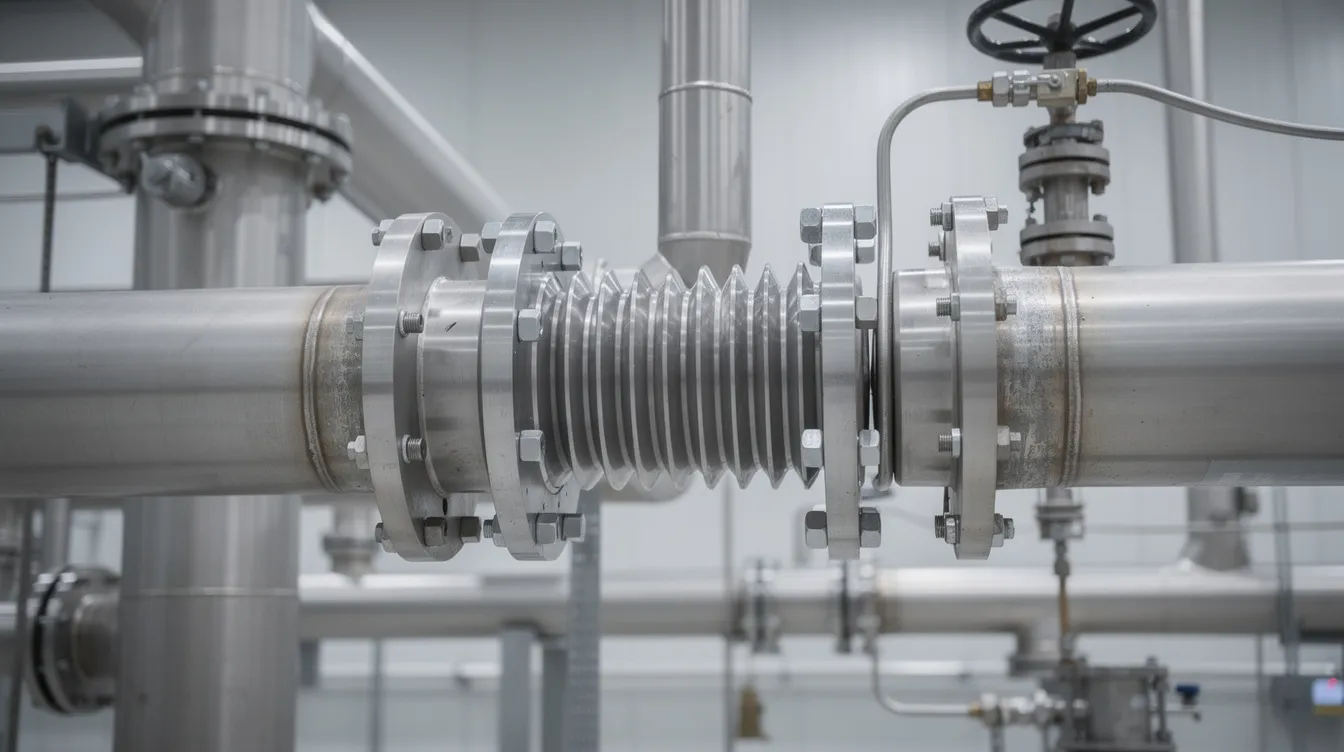
Some of the main types of pipe and duct joints:
-
Metal bellows expansion joints (can handle up to 1,000°C, 100 bar)
-
Rubber expansion joints (can handle up to 150°C, 20 bar)
-
Fabric expansion joints (can handle up to 500°C, 0.1 bar)
-
Slip type expansion joints (can move axially for 1 to 3 meters)
-
And other specialty types: pressure-balanced, gimbal, hinged, universal, toroidal
What type you choose depends on what kind of stuff is inside your pipes (steam, oil, flue gas etc.) and how fast it’s moving, as well as how much pressure and movement you expect and whether the whole system needs to be able to absorb vibration.
Metal Bellows Expansion Joints
Bellows expansion joints are made out of thin, corrugated metal (usually a special kind of stainless or nickel alloy). They can handle movement in lots of different directions, depending on how they’re set up.
Some of the most common ways they’re used:
-
For small movements (usually up to 25 mm)
-
For bigger jobs (up to 150 mm of lateral movement with a spool in between)
-
For jobs where there’s a lot of pressure and they need to be extra strong (up to 200 bar)
Some of the key parts that go with these joints:
-
Tie rods that help absorb the pressure and take some of the stress off the anchors
-
Limit rods that make sure the joint doesn’t get too stretched out
-
Internal liners that help protect the joint from getting damaged by the stuff flowing through it
-
External covers that help protect the joint from getting damaged by the sun or other external factors
These joints are made to last a long time, with some designs good for up to 10^6 cycles. They get used in applications like steam lines (500 psig, 800°F), turbine exhaust, and hot process piping.
Pressure-Balanced and Other Metal Joints (Gimbal, Hinged, Universal)
Pressure-balanced expansion joints are special – they have extra bellows that are positioned so they cancel out the pressure, which makes them a lot safer and easier to work with. They’re really good for high-pressure systems where you can’t afford to have the whole system pulling on the anchors.
Some of the common designs for this type of joint:
-
Pressure-balanced joints that are in-line (for straight runs) and just absorb the compression and extension without sending any pressure to the anchors
-
Elbow pressure-balanced joints that manage thermal growth at bends in high-pressure lines
-
Hinged expansion joints that allow for movement in one plane, using hinges and pins to keep it all together
-
Gimbal expansion joints that can turn in lots of different directions, using a special ring to go around the bellows
Universal joints are pretty versatile – they’re good for handling both lateral and axial movement. They’re pretty common in big systems with lots of movement, like big hot gas ducts, turbine connections, and big refinery headers.
Rubber and Elastomeric Expansion Joints
Rubber Expansion Joints use molded or wrapped Elastomeric Bellows (EPDM, NBR, neoprene) which get a helping hand from fabric plies, steel rings or even cable. They get attached via flanges that can be bolted on and normally run from -50 to +150 degrees Celsius at pressures of up to 16 to 25 bar.
Some Key Configurations:
-
Single arch and multi – arch bellows for absorbing both Axial and Lateral Movement. Guess which ones are good for Angular Misalignment?
-
Spherical (ball) joints for when you need to accommodate some major Angular Misalignment
-
Reducing joints that let you join pipes of different diameters
So Why Choose Rubber Expansion Joints over Metal ones?
-
They are way better at vibration damping (around 90% isolation and damping ratios of over 0.2)
-
They reduce noise transmission by around 20 dB
-
They last longer in corrosive fluids
-
They can put up with installation tolerances and minor misalignment (no stress)
-
They offer electrical isolation between pipe sections
These expansion joints are used in anything from pump suction and discharge to HVAC equipment connections, cooling water systems & even water treatment facilities – basically anywhere where vibration and pipe movement matter.
Fabric and Non-Metallic Expansion Joints
Fabric joints are totally flexible, high pressure gas and air handling connectors where metallic bellows just wouldn’t cut it. They are super useful for HRSGs, flue gas ducts and huge industrial ventilation systems working under extreme conditions.
Here is what they are made of:
-
High-temperature fabrics (silicone-coated fiberglass, ceramic cloth keep it real)
-
Insulation barriers to keep things under control
-
Gas tight membranes (PTFE, Viton) to ensure nothing slips up
-
Metallic frames to keep them attached and all that jazz
Fabric joints can handle huge movements – we are talking axial travel of 300 mm and lateral of 200 mm – but they top out at approximately 0.05 bar continuous pressure. They are very good where there are temperature gradients (ducts at 400°C and joint surface at 200°C) and/or fly ash or abrasive media needing separation between steel ducting and flexible seals.
Slip-Type Expansion Joints
Slip type joints work on a completely different principle – your pipe (slip sleeve) slides inside a barrel with packing material (usually graphite based) in a stuffing box that keeps a pressure tight seal even when the pipe is moving axially.
These joints can handle pure axial compression and extension with strokes of 1- 3 meters – far exceeding what any metallic bellows could do. However – they can’t cope with any lateral deflection or angular deflection – and that means you have to make sure they are precisely aligned with guides every 10 times the pipe diameter.
Slip type expansion joints are perfect for high-pressure steam mains and large diameter water lines where a big axial stroke is needed. Maintenance involves checking the packing, and keeping it just loose enough to run smoothly but tight enough to prevent leaks. It also means you need to re-align it every now and then.
Sealing Systems: Foam, Compression Seal, Winged, Inflated, and Strip Seals
These Gap Seal types are used in all sorts of high pressure applications like bridge decks, parking garages & building joints where you really need to keep things watertight.
Some Popular Foam expansion joints:
-
Closed cell EVA-PE (density 50-100 kg/m³) all stuck together with some epoxy
-
Movement capability of around 50% on each side
-
Really easy to retro fit
-
You can get impregnated open cell variants for existing structures
Compression seal joints:
-
Neoprene cellular seals (durometer 50-70) -super tough
-
Movement range of around 35% up to about 65 mm gaps
-
Installed under compression with loads of lubricant
-
Not really suited to staged construction pours
Winged joints:
-
Some thermoplastic profiles with winged thermoplastic profiles that just sort of ‘snag’ into the concrete
-
Extensions for the seal that can handle a bit of movement
Inflated systems:
-
Air pressurized neoprene bladders stuck together with epoxy
-
Need loads of people & a good setup to get them in correctly
Strip seals:
-
Some elastomeric seal strip that gets locked between steel edge members
-
Movement range up to about 100 mm
-
Normally they last 20 years – which is good
-
Highway bridge joints where a watertight seal is essential
Manufacturing Methods for Rubber and Metal Expansion Joints
Understanding how these expansion joints are made is a great way to evaluate their quality, Lead times and performance limitations.
Wrapped fabric-reinforced rubber bellows: Think of it as an old fashioned craft. People hand wrap rubber sheets and fabric plies over a bellows -moulded mandrel and stick steel wires in where needed. Vulcanization cures at 150°C for about 2 hours. This method is really good for custom or big diameter joints but is labor intensive.
Molded rubber bellows: Think of it like a machine shop. You preform and compress/inject mould rubber into a cylindrical mandrel to produce consistent shapes with ±0.5 mm tolerances. Ideal for medium size joints in production runs.
Automated winding: Think of it like a factory. A robot places rubber and reinforcing fibres at controlled angles (45-90°), giving you repeatability and tailored stiffness profiles along the bellows length.
Metal bellows fabrication:
-
You roll and weld tubes from sheet
-
Forming convolutions via hydroforming (700 bar) or mechanical processes
-
Cold working to give it more strength
-
Welding flanges and accessories* NDT inspections to meet ASME requirements
EJMA standards are what govern spring rates – typically 0.5-5N/mm, and fatigue verification to ensure the joint will last as long as designed to.
Accessories and Design Considerations for Expansion Joints: What Matters Most
You can’t really define a joint by just its core elements – bellows or seal. The real story is in the accessories & supports that come with them. The stuff you add can make all the difference in a joint performing safely over its lifespan.
Internal liners – A Must For Tough Environments
If you’ve got fluids moving fast enough to erode the bellows (above 30m/s), internal liners can help prevent that. They also reduce turbulence inside the joint by about 50% which is a big deal, and they keep particulates from getting in & causing damage.
External Covers: Protecting The Joint From Damage
External covers give some basic protection from the outside world – they keep the skin temperature of the joint below 200°C, which is good for your personnel – and they also help shield against UV damage that can break down the materials over time.
Limiting Movement – Tie Rods vs Limit Rods
Limit rods & tie rods are both used to control movement in a joint. Limit rods are used to prevent over-stretching or compression of the joint beyond its safe limits. Tie rods are used to keep the joint from over-extending, but they can also be used to control how far the joint is allowed to move. Either one needs to be sized up to EJMA specs.
Keeping The Joint Clean – Particulate Barriers & Purge Connections
You can use things like ceramic fiber blankets to keep dust, ash, and condensates out of the joint. And, if you want to be extra careful, you can add a purge connection that blows clean gas into the joint at around 0.1 bar to keep anything nasty from getting in.
System Design Essentials You Can’t Ignore
When you’re designing a system that uses expansion joints, you need to make sure you’re doing it right. Some of the things you should keep in mind are:
-
Anchors that can handle 2x the pressure of the system being controlled
-
Guides that keep the joint from moving more than 1/3 of its own limit
-
Regular inspection intervals of 6-12 months to check for cracking, corrosion, misalignment and other issues
Choosing The Right Expansion Joint For The Job
When it comes to selecting the right joint, it’s all about matching the needs of the job to the capabilities of the joint.
High-Pressure, High-Temperature Systems Demand Special Treatment
For those kinds of systems, you want to use a joint that’s designed to handle the heat, like a metal bellows, and that has some tie rods to keep the joint from over-extending.
For Vibration Isolation & Noise Control: Rubber Expansion Joints Are The Way To Go
If you need to dampen out vibrations and reduce noise levels, rubber is your best bet. It’s a great material for isolating the joint from the movement of the system around it.
Large Low-Pressure Duct Movements Require Flexibility
Fabric joints are really good at handling big movements while staying flexible – good for systems that need to move a lot.
Foam & Compression Seals: The Right Choice For Bridge Deck Gaps
Those kinds of seals are great for keeping water out of a joint – even under heavy traffic loads. Plus, they’re good for big movements.
When It All Comes Down To Axial Movement
If the only thing you need the joint for is pure axial movement in a high-pressure system, you’re best with a slip-type joint. They can handle up to 3 meters of travel while keeping the system contained.
If you’re building something that’s going to be hit by earthquakes, or has some other tough environment that needs special care, you probably want to consult with a specialist.
The Bottom Line
Getting the right expansion joint is what keeps your system running safely over its lifespan. Choose the wrong one and you could end up with a major disaster on your hands – costly repairs, bridge closures that can cost hundreds of thousands of dollars a day… You want to make sure you get it right.