
Non-metal expansion joints are a vital component of modern piping systems and duct networks – whether you’re talking about HVAC systems, power generation facilities, chemical process lines, or anything else. They take the strain out of thermal expansion, vibration, and misalignment in the pipes – all while keeping a leak-tight seal – without needing any of that metal bellows business.
Operating envelopes depend on the material you’re using: rubber joints can handle a pretty wide temperature range of -40°C to about 150°C, at pressures up to 16 bar, so you’re looking at pretty high performance. Fabric joints handle even larger movements at low pressures in ducts. Some designs using PTFE go way further, extending all the way up to 260°C with aggressive chemicals.
So what’s the big advantage of non-metal expansion joints? Well, for starters, they’re highly resistant to corrosion – a huge plus in those chemical and flue gas environments where everything’s trying to eat away at your equipment. They also handle noise and vibration way better, reduce stress on equipment, and are generally a heck of a lot simpler to install compared to metal.
What are Non-Metal Expansion Joints?
Non-metal expansion joints are essentially flexible connectors – made from elastomers, fabrics, PTFE, or even composite materials -designed to soak up the movement caused by thermal expansion, mechanical stress, and installation tolerances. They break the continuity of those rigid pipes so they don’t damage the equipment at the other end, like pumps, fans, and turbines.
These joints handle three main types of movement: the first’s axial movement (that’s along the pipe centreline, typically about ±20 mm for a standard cooling water joint), lateral offset (for when you’ve got misalignment that needs compensating for), and angular rotation (for when your pipes are twisted in weird and wonderful ways).
The Construction
A typical non-metal expansion joint consists of a flexible core (made from rubber, fabric, or PTFE), integrated flanges for connection, and reinforcing layers to give it some serious flexibility and durability. For high-temperature applications, we’ve got insulation pillows and flow liners to keep the heat in and erosion at bay.
Types of Non-Metal Expansion Joints
There are four main families: rubber, fabric, PTFE-based, and elastomer-fabric composite designs, each one tailored to specific operating conditions.
Rubber Expansion Joints: These guys can be found in a range of geometries – single-arch, wide arch, and multiple-arch – and are made from EPDM, nitrile, neoprene, butyl, or natural rubber. Sizes go from DN25 to DN3600, and they can handle pressures up to 16 bar. They’re commonly used in chilled water loops, cooling water systems, and pump connections – they do a fantastic job at absorbing movement and isolating vibration.
Fabric Expansion Joints: These multilayer belt-type designs feature glass fabric with silicone or EPDM coatings, fluoroplastic barriers, and stainless steel reinforcement mesh. You’ve got standard strokes in 4, 8, and 12 inches for single units. They’re used mainly in rectangular or circular duct systems for things like flue gas, HRSG units, and FGD plants.
PTFE & Fluoroplastic Joints: These guys handle aggressive chemicals like chlorine, strong acids, and solvents at temperatures up to 260°C. They’re a no-brainer for chemical plants and scrubber systems, where standard elastomer materials would get chewed up in no time.
Elastomer-Fabric Composites: These hybrid designs combine rubber bellows with textile or aramid fibre reinforcement – they improve pressure capability, vacuum resistance, and fatigue life compared to pure elastomer expansion joints.
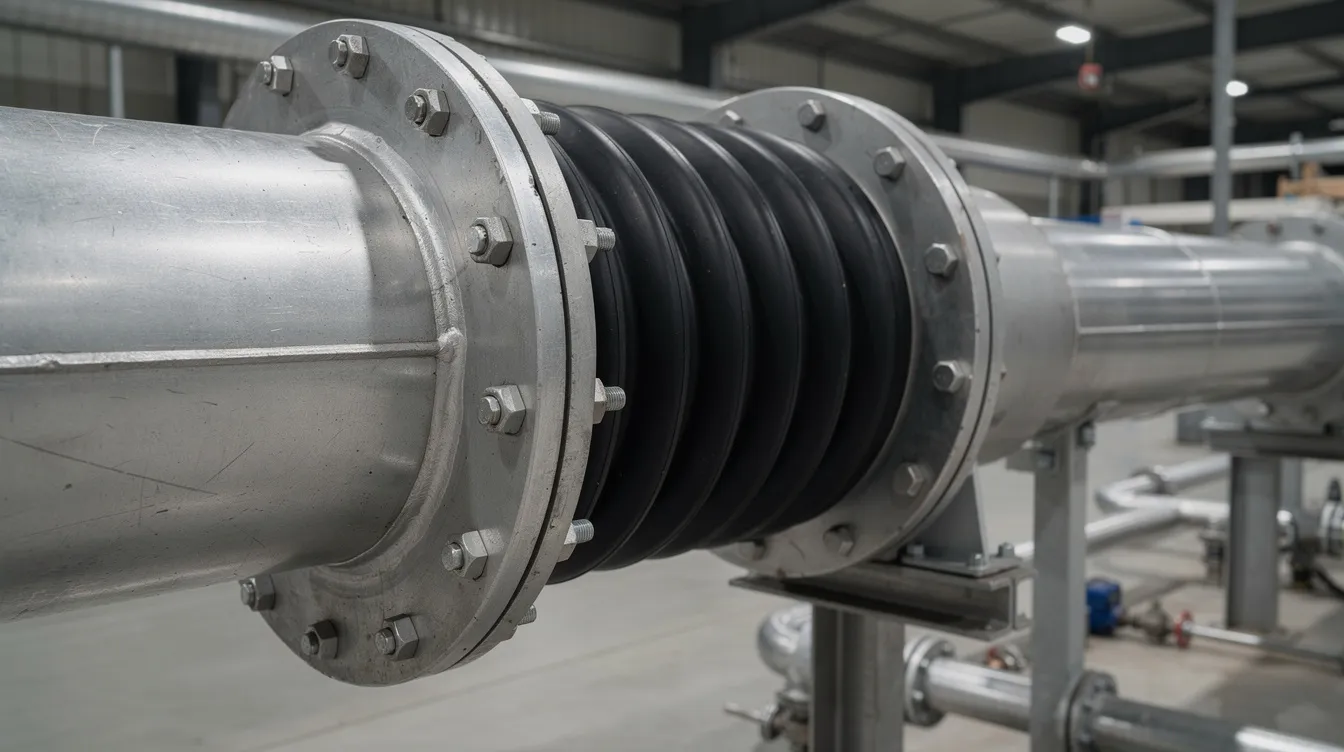
Non-Metal vs. Metallic Expansion Joints
They both manage movement, but they’ve got completely different performance envelopes. Metal expansion joints excel at extreme temperatures and high pressures where space is really tight. They’re perfect for superheated steam lines at 480°C and 60 bar.
Non-metal joints, on the other hand, offer superior corrosion resistance in chemical and flue-gas environments, are way better at acoustic damping for noise reduction, have very low spring rates that put minimal loads on equipment nozzles, and are a heck of a lot simpler to replace compared to their metal cousins. A boiler flue gas duct operating at 350°C with low pressure typically employs fabric joints for optimal performance.
Comparison of Non-Metal vs. Metallic Joints
|
Characteristic |
Non-Metal Joints |
Metallic Joints |
|---|---|---|
|
Temperature |
Up to 260°C (PTFE) |
Up to 700°C |
|
Pressure |
Up to 16 bar |
Very high pressure capable |
|
Flexibility |
Excellent multi-directional |
Limited |
|
Corrosion Resistance |
Superior |
Requires coatings |
|
Maintenance |
Simple replacement |
Complex procedures |
Applications of Non-Metal Expansion Joints
These joints are used in all sorts of industries, providing flexibility and reliability in the most demanding environments.
HVAC and Building Services: Air-handling unit connections, fan discharge, chilled water and hot water loops operate between 5-130°C. Rubber joints near pumps and chillers really reduce noise transmission and prevent vibration-induced fatigue.
Power Generation: Fabric joints dominate flue gas duct applications in coal- and biomass-fired boilers, handling large movements during start-up and shutdown cycles. HRSG units and FGD systems rely on advanced fabrics with Darlyn coatings for severe chemical environments.
Chemical and Petrochemical: PTFE-lined joints protect against sulfuric acid, sodium hypochlorite, and aggressive solvents. Standard elastomer joints serve cooling water, brine circulation, and utility lines where the medium is less corrosive.
Water and Wastewater: The rubber joints on filtration trains and pump stations help absorb the pulsations of the pumps, compensate for any misalignments, and withstand all sorts of media – including treated wastewater and seawater in desalination plants.
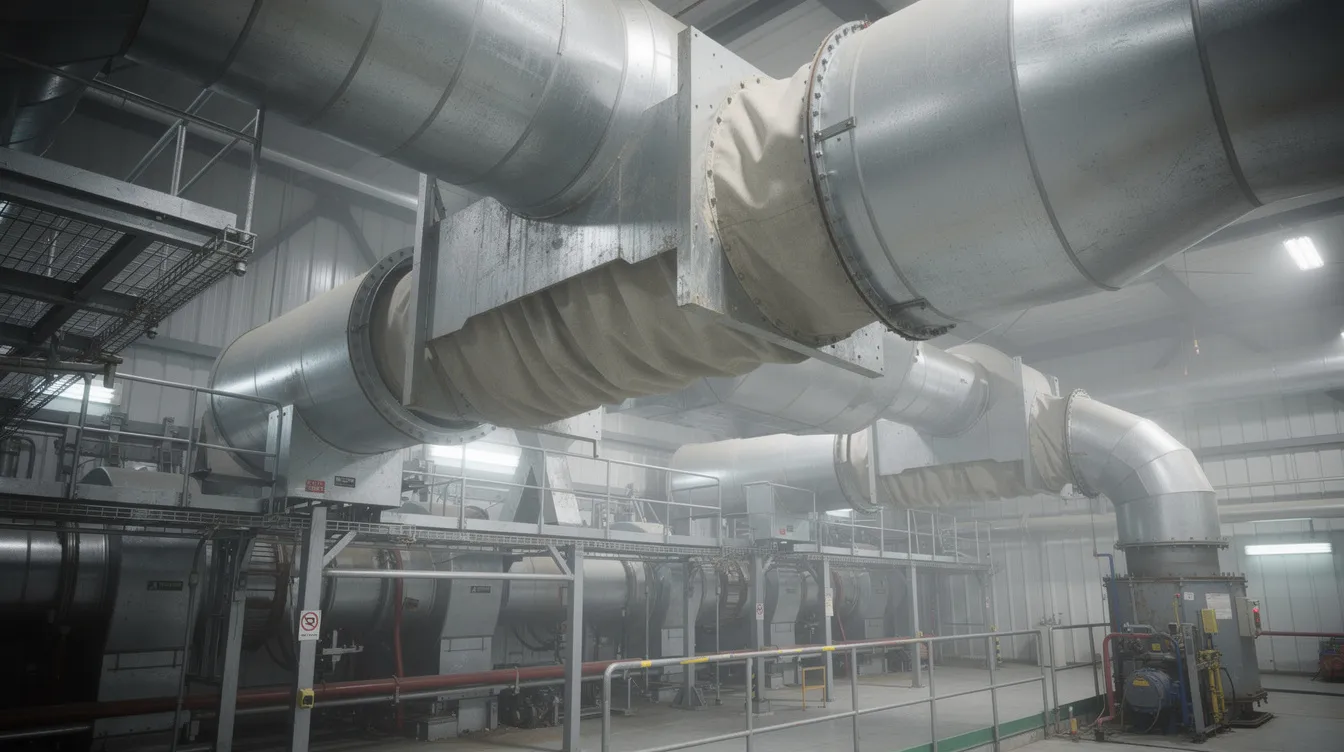
Key Selection Criteria for Non-Metal Expansion Joints
Choosing the right expansion joint is all about matching the design and the materials to the specific conditions of the process you’re trying to deal with. So, you need to consider things like continuous and peak temperature, design pressure and vacuum conditions, the velocity of any gases that are involved along with any solids that might be in there, and also the chemical composition of whatever it is you’re dealing with.
Movement Requirements: Work out how much movement is required per joint – both in terms of distance and the type of movement that’s needed. Its a good idea to use manufacturer movement tables to get this right, rather than just trying to estimate it. You also need to think about how many times the system is going to go through a full cycle per year and where the anchor points for the system are going to be.
Material Selection: You have a choice of different materials to use for the expansion joint – EPDM (that’s water-based systems), nitrile (hydrocarbons), neoprene (that gives good resistance to ozone), FKM (that’s used in chemical-based systems) and PTFE (which is really good in highly corrosive service). The choice will depend on how well the material can withstand the chemicals in the system, and how high the temperature is likely to get.
Mechanical Factors: You need to make sure you get the physical size right – that means the diameter of the joint and the length from one end to the other. Also, check the flange standards – are you using EN1092 or ASME B16.5, for instance? And also make sure you get any control units or tie rods you need. Finally, check whether you need flow liners or outer cover protection to keep things working smoothly.
Selection Checklist: So what do you need to check? That’s pretty simple – the composition of the medium you’re dealing with, the temperature range, whether you’re working with pressure or vacuum, how much movement the joint needs to be able to handle, the size and which connection standards you need to use.
Installation Guidelines for Non-Metal Expansion Joints
Even if you’ve got all the specifications right, the joints are not going to last very long if they’re not fitted properly – you need to make sure the manufacturer’s tolerances are met.
Alignment: The pipe needs to be properly aligned – none of this twisting the bellows business. Wait until everything is in place before releasing any shipping restraints.
Flange Connections: Tighten the bolts in a cross pattern – and make sure you use the right torque values. Its a good idea to use flat washers or backing bars to get the best seal. And don’t forget – any gaskets should only be inserted if the manufacturer has specifically told you to.
Anchoring: The anchor points and guides need to be fitted so that the joint can move freely – it shouldn’t be carrying any structural loads. And remember – expansion joints aren’t there to provide pipe supports.
Protection: Get the joint properly insulated if it’s going to be in a very high temperature environment. If you’re dealing with chemicals, you’ll need splash shields. And for outdoor use, make sure you use something that will keep the rubber safe from UV.
Inspection, Maintenance, and Replacement
These expansion joints are wear and tear components – so you need to check on them regularly to make sure they’re still working properly.
Inspection Points: Keep an eye out for surface cracking, blistering or hardening of the rubber, delamination of any fabric layers, loose clamping hardware, erosion on gas-side faces and hot spots on the insulation.
Intervals: Have a visual inspection every 6-12 months in industrial plants – more often if you’re dealing with high temperature or abrasive services. And schedule a more detailed shutdown inspection based on how long the system has been running.
Common Failures: Chemical attack from something unexpected, overheating beyond the design limits, mechanical over-stretching because you forgot to fit the anchor points – and damage during maintenance is another possibility.
Replacement Planning: Keep track of the original nameplate information, note down the date of installation and consider upgrading to a better material when you’re sourcing a replacement – that way you can get one that’s up to date with the latest market standards.
Future Trends and Innovations in Non-Metal Expansion Joints
It’s all about advancing technology and making a success of increasingly tough environmental regulations and longer maintenance intervals. New fluoroelastomers that are even more resistant to chemicals and higher temperatures are being developed. And digitalization is making it possible to predict when a joint needs to be replaced, helping facilities to make things more efficient and achieve better overall performance across all sorts of demanding applications.
When you’re specifying non-metal expansion joints, its all about finding a balance between the cost of owning and running the system, how reliable it is and just how safe it is. If you’re dealing with high temperatures or highly corrosive chemicals, you need to find a partner who really knows what they’re doing – the right specifications and combination of materials can make all the difference to getting decades of trouble-free operation.