
Expansion joint covers bridge the gaps that are deliberately engineered into buildings to allow buildings to expand & contract from heat & cold, from earthquakes or landslides, from wind or stormy weather, & from the settlement of new buildings. These clever systems keep your building safe, watertight, & looking good all over the building, including the floors, walls, ceiling & roof.
You’ll find ’em in big commercial towers, hospitals, airports, car parks, sky bridges, buildings that are anchored to the ground to stop them being knocked about too much by earthquake waves, & in the walls of buildings that have been designed to look really fancy from the outside. This article gives the lowdown on what they are, how they work, the different types that are available, and what you need to think about when you’re choosing the right system for your project.
What Are Expansion Joint Covers?
Expansion joint covers are actually just protective covers that are put over the gaps that are engineered into concrete slabs, walls or decks to stop them cracking. But they do a lot more than just that. They give you a barrier that keeps the water out, offers some protection against fires, and ensures that your floors, walls & ceilings stay in good condition.
Think about it this way. If you’re building a 40 floor office block in Sydney, you’ll need to have joints every 1-2 metres to cope with the heat & cold, and the wind. Or if you’re building a big airport terminal, you’ll need something much more heavy-duty that can handle the constant movement of luggage trolleys.
The main reasons we use expansion joint covers:
-
They let buildings move back & forward, sideways & up & down without stressing the floors, walls & ceilings.
-
They keep the edges of the building safe from damage from trolleys, wheelchairs or other wheeled traffic.
-
They keep the water out by using special seals that can stretch.
-
They keep the building safe from fire by using special fire-proof materials.
-
They give a smooth, solid surface that complies with building safety standards
Key Benefits of investing in really good quality expansion joint systems
Using a really good quality expansion joint can really pay off in the long run by reducing the chances of things going wrong. For example, using a light duty cover on an airport landing strip will likely cost a lot to fix when the trolley crashes into it & does some serious damage.
The benefits:
-
They help buildings expand & contract without damaging the floors, walls & ceilings.
-
They can cope with movement as big as 50% of the width of the joint in earthquake prone areas
Safety benefits:
-
They give a smooth surface that complies with the safety standards in Australia (the edges must be no more than 5mm high).
-
They have a special surface that helps people avoid slipping, particularly in hospital corridors or shopping centre walkways.
-
They are strong enough to carry the weight of people or vehicles.
Durability benefits:
-
They last for a long time, even in the full sun or in places that get attacked with salt or other chemicals.
-
They can last for 10-15 years in a shopping centre or other place that gets a lot of wear & tear.
Reducing the risks:
-
They help keep the water out & stop the building getting damaged by corrosion.
-
They keep the fire from spreading for as long as 2-4 hours in emergency situations.
-
They keep buildings standing after an earthquake, even when the ground has moved a lot.
Where you’ll find expansion joint covers
You’ll find expansion joint covers in all sorts of modern buildings, each one specifically designed to meet the needs of the building:
-
Floor joints in shopping centres, hospitals & airports: We need to be able to carry the weight of trolleys or wheelchairs, so they have to be really strong. We also need to be able to clean them easily, so they get a special finish.
-
Wall & ceiling covers in hotels & atrium: They can be mounted on the wall or be hidden from view. They can even be painted to match the finish on the rest of the building, so they’re not noticeable.
-
Roof & façade systems: We need to make sure that they’re weatherproof & can handle the movement of the building in the wind.
-
Car parks & walkways: They have to be strong enough to handle the weight of cars driving over them, and they have to be able to withstand the cold weather & the salt that gets sprayed on them to stop them from getting icy.
-
Sky bridges & buildings that have been anchored to the ground to stop them moving about too much: We need to be able to carry a lot of movement, and we need to be able to absorb a lot of energy to stop the building being damaged in an earthquake.
-
Stadium concourses: They need to be able to handle the movement of people rushing about in big crowds.
Types of Expansion Joint Covers
Here are the main types of systems that you’ll come across when you’re looking for the right expansion joint cover:
|
Type |
Movement Range |
Typical Applications |
|---|---|---|
|
Floor cover plates |
25–300mm |
Malls, airports, public buildings |
|
Recessed/flush-mounted |
Variable |
Hotels, hospitals (tile, carpet, terrazzo infills) |
|
Wall and ceiling |
±25mm typical |
Atria, public buildings, offices |
|
Roof and exterior |
Up to 500mm |
Exposed decks, façades, membrane interfaces |
|
Seismic covers |
±100mm+ multi directional |
High seismic zones, base-isolated structures |
|
Fire rated systems |
Per assembly |
Floors, walls, ceilings requiring FRL ratings |
Seismic joint covers are designed to handle the big movements that happen in a big earthquake, often by using special mechanisms to absorb the energy. Fire-rated joint systems use special fire-proof materials that have been tested to make sure they can keep the fire out for a long time.
Materials & Design Options
When we’re designing & building expansion joint covers, we use a range of materials & techniques to make sure that they’re fit for purpose:
-
We use extruded aluminium (lightweight & can be anodised to stop it rusting).
-
We use stainless steel (resists corrosion, so it’s great for coastal areas).
-
We use galvanised steel (cost-effective, but only for internal areas like car parks).
-
We use special elastomers like EPDM (can handle temperatures from -40 to 120°C) or TPE (has high tear strength).Finishing options span mill finish, powdercoated RAL colours, brushed stainless steel, and infill compatible for tiles or terrazzo – it really is a super versatile choice. Special options down the track include noise reducing inserts, tamper resistant fixings, and hidden fasteners for a sleek finish.
Coastal projects in particular should make sure to specify 316 stainless to combat that pesky chloride corrosion. And for food production areas, better be sure to use FDA approved seals.
Engineering Considerations When Selecting an Expansion Joint Cover
When it comes to choosing the right joint cover, its all about movement, loads and how the building is used, more so than what it looks like. A structural engineer needs to get a good idea of how much movement to expect in each direction before specifying the right system.
Movement requirements:
-
Thermal: about 0.5mm/m/°C for concrete as a rough guide
-
Seismic: up to 1% drift in areas with high seismic risk
-
Creep and shrinkage: about 0.3mm/m/year
Gap size and tolerance:
-
Typical joint widths range from 25mm to 500mm+ in places like podiums and atria
-
Allow for a ±10mm construction tolerance
Loading conditions:
-
Pedestrian areas: 2-5kN/m²
-
Car parks: 13kN per wheel – and 50kN for forklifts – so that’ll be a big one
-
Fatigue rating: 1 million cycles at the rated load
Environmental factors:
-
UV exposure (ASTM G155, 2000 hours)
-
Freeze-thaw cycles (200 cycles)
-
De-icing salts (ASTM B117, 1000 hours)
Regulatory compliance:
-
Fire ratings in line with the relevant building codes
-
Accessibility – as per AS 1428 (or better)
Coordinating with Other Trades
To ensure the joint cover performs well, there needs to be early coordination between the structural engineer, architect, waterproofing consultant and installer. Think about slab edges, rebates, blockouts, waterproofing terminations and ceiling grid interfaces.
You’d need to develop detailed joint layout drawings that show all the joints, movement requirements and the proposed joint cover. And include the manufacturer’s suggested fixings and substrate preparation in the specs.
Testing, Certification and Performance Warranty
Independent and in-house testing is done to verify the joint cover’s safety and durability. You get full scale movement tests that simulate thermal cycles and seismic events on floor, wall and roof assemblies.
Fire testing to AS 1530.4 (or UL 2079) confirms the fire rated system performance. Then there’s load and fatigue testing – applying rolling loads for example, so 35,000+ cycles at 13kN without any issues or seal extrusion on car park joints.
Get the test reports and certificates in the project submittals. Video demonstrations of seismic testing can build confidence for more complex projects.
Documenting Compliance in Your Project
You should request test summaries, calculation notes, installation manuals, and maintenance guides from the manufacturer. Capture all the required standards and performance criteria in the specification section. And third party certifications will come in handy for approvals and inspections.
Expansion Joint Covers for Car Parks and Trafficable Surfaces
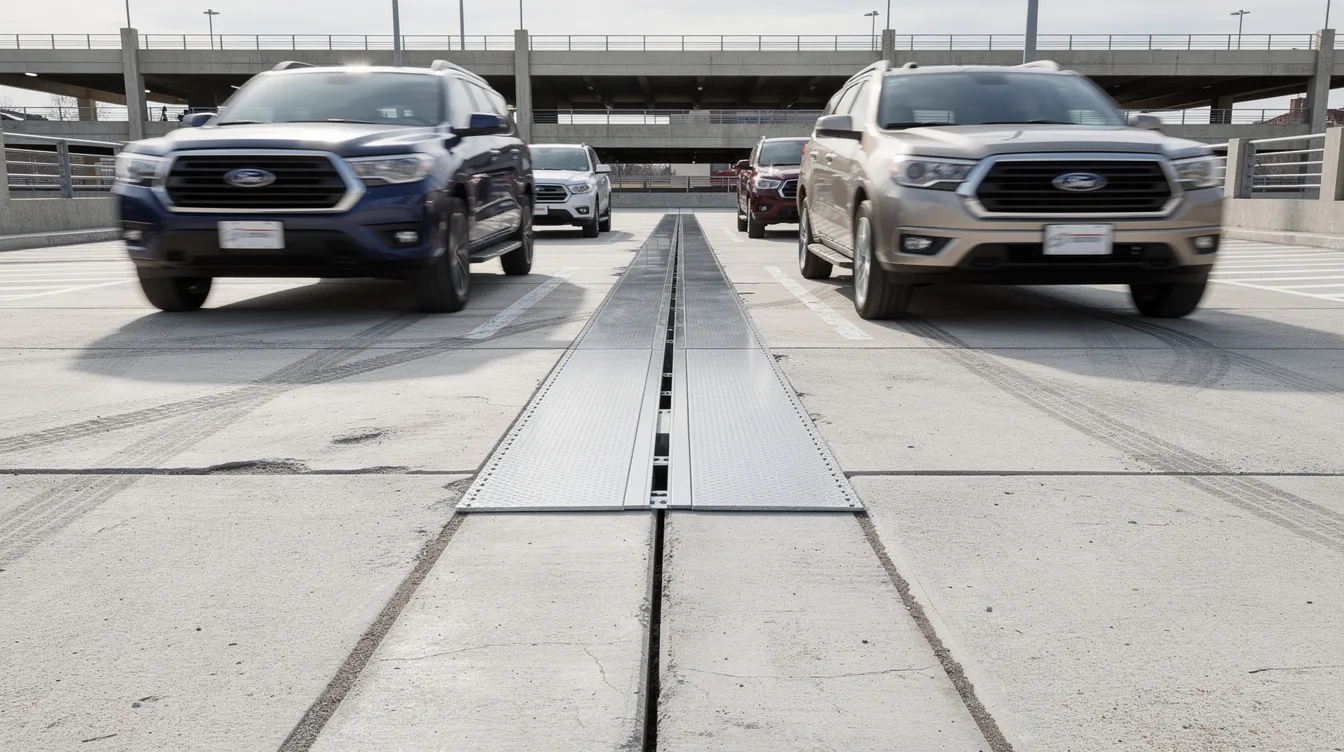
Car parks present some unique challenges – think concrete slab shrinkage cracking, adhesive bond failure in cold conditions, water ponding and the dreaded “click-clack” noise from loose fixings.
You need high performance car park systems that feature hybrid aluminium channels with 50mm depth TPE seals. Designed to resist bond failure at sub-zero temperatures, these will withstand 13kN/wheel loads at 5km/h over 35,000 cycles with minimal wear.
Integration with polyurethane deck coatings will ensure waterproof continuity. And ramp details using counter-sunk plates will prevent rocking under braking forces.
Retrofit and Remedial Solutions
If the existing car park has issues with leaks or noisy plates, low profile retrofit systems can be installed into existing slabs with minimal demolition.
Before installation, you’ll need to assess the substrate condition, previous coatings, and moisture (<4% by meter).
From Concept to Installation – Typical Project Process
Here’s a typical workflow that progresses through a bunch of stages:
-
Concept design: Early consultation on joint locations and preliminary cover types
-
Design assist: BIM coordination, clash detection, shop drawings supplied for review
-
Submittals: Product data, samples, and coordination drawings for approval before purchase
-
Mock-ups: Sample joints verify aesthetics and installation sequence
-
Installation: Trained installers follow manufacturer guidelines, with an emphasis on substrate preparation and correct fixings
-
Handover: Movement checks, documentation of warranties, and maintenance instructions
Ongoing Maintenance and Lifecycle Planning
Well-installed systems need periodic inspection, which includes cleaning debris from seals, checking fixings, and inspecting after seismic or extreme weather events.
Include expansion joints in the maintenance schedules with annual inspection intervals. Choosing robust systems and proper detailing will significantly reduce lifecycle costs – think about it, robust initial choices can cut costs 40% by halving interventions.
How to Choose the Right Expansion Joint Cover for Your Project
When it comes to choosing the right joint cover, it’s all about movement, environment and compliance – not what it looks like alone. So follow this approach:
-
Define joint locations and widths via laser scan
-
Quantify expected movement in each direction
-
Classify traffic and loads – pedestrian through to vehicular4. Confirm whether we have all the fire, water & acoustic structural requirements nailed down
-
From the whole range of systems out there – narrow down the options to the ones that are worth taking a closer look at
When comparing the upfront costs of different systems, it’s not just about price – we need to think about how complicated the installation is going to be, what evidence there is that the thing actually works, and how long it’s likely to last. For instance, you might have a high-end system that costs $500 per metre that ends up outperforming some low-end option that costs just $200 per metre but is only good for about five years – which would ultimately end up costing you more in the long run.
Get our experienced technical teams on board right from the start of the design phase. Often manufacturers will give us free audits on the really high-risk areas of the building so we can work out the best way to keep total costs down over the 50 year life of the building.